We test the things we sell and the things we rejected, and publish the numbers either way. It is the only part of this business that keeps working after we stop paying for it.
One email a monthTeardowns and measurementsNo offers, ever
Guides
The long answers.
One cluster for each thing we sell.
Every source is linked, and where the evidence goes against our own
product we have left it in and said so.
Measured in Castle Rock, ColoradoDigital micrometer, 0.001 mmThree bags per brand, mid panel
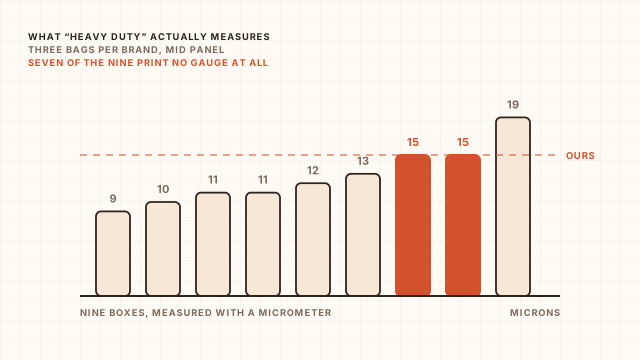
Thickness is the only thing a waste bag does. There is one job and one failure mode, and the distance between them is the gauge of the film, measured in microns. So we bought nine boxes, took three bags out of each, and measured the mid panel away from the seam.
Seven of the nine printed no gauge anywhere.
Not on the box, not in the listing, not on the brand's own website. Two of those seven used the phrase "extra thick" on the front. One used "heavy duty" twice. We are not going to name them here because a single box is not a production run and we are not interested in picking a fight we cannot support with a sample size. We will name them when we have measured ten boxes of each from different lots.
What the numbers looked like
The thinnest came in at 9 micron, which is roughly a supermarket carrier bag.
Four of the nine sat between 10 and 12 micron.
Two were at 15, which is where ours sits.
One measured 19 micron and was noticeably stiffer in the hand and bulkier on the roll.
The spread between two boxes both described as "heavy duty" was 7 micron, which is most of the way to double.
What we take from it
Not that thicker is always better. 19 micron is genuinely more bag than most dogs require, and you carry that difference on every walk. The point is narrower than that: a category where nearly nobody publishes the one number that matters is a category where the word on the front of the box has stopped meaning anything.
So we print ours. 15 micron, on the front, next to the count. If you have a very large dog and want more, buy a 20 micron bag from somebody else and we will not try to talk you out of it.
What we have not done
We have not load tested any of them. A gauge figure and a drop test are different claims and we are not going to let one stand in for the other. The load test is next, with a published method, and we will put our own bag through it on the same film and the same day as everybody else's.
Rejection · sourcing
We priced eleven fountains, and then we stopped selling ours.
Eleven units quotedUS warehoused stock onlyLanded cost, not list price
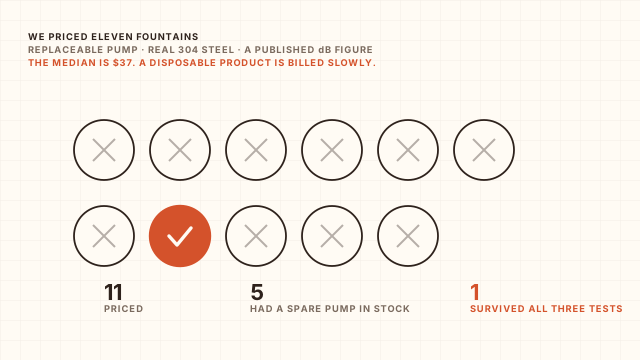
The median retail price of a cat water fountain is somewhere around $37. We know, because we spent a fortnight quoting them. Ours is $89, which is more than twice that, and if you are going to charge that you had better be able to say why in one paragraph.
Here is the paragraph. At $37 you are buying an ABS plastic body with a pump that is either glued in or sold only as part of a replacement assembly nobody stocks after eighteen months. When the pump goes, and it always goes, the fountain is landfill. So the real price of a $37 fountain is $37 a year, for as long as you have a cat.
A disposable product is not cheap. It is just billed slowly.
What we were actually shopping for
Three things, in this order.
A replaceable pump that somebody keeps in stock. This eliminated six of the eleven immediately. Not because the pumps were bad, but because no spare existed to buy.
Real 304 stainless at the bowl. Several units are described as stainless and are stainless coloured. One was a chrome finish over plastic, which you can tell by weight in about two seconds and not at all from a photograph.
A published noise figure. This is the single most common complaint in the category and almost nobody will commit to a number. Two of the eleven gave us one.
What survived
One unit, and it is not the one this article originally named. The fountain on the shelf today is 304 stainless throughout the bowl and body, 12.6 by 8.7 by 8.8 inches, holding 1.8 gallons, with a pump the maker rates under 35 decibels. It lands with us at $42.36 and we sell it at $89. That is a 52 per cent margin and we are not going to pretend it is thinner than it is.
The part we are least comfortable with
Two parts, and they are both about what happens after year one. We cannot buy you a spare pump for this unit, and we cannot buy you a replacement filter either. Everything above about disposability was written as an argument against other people's fountains, and today some of it lands on ours. We are looking for both. The day we find them this paragraph changes and we will say when.
And the honest commercial note
The original version of this paragraph said the filters are where a small shop makes its money, at $19 for six, four months at a time. That was true of the plan and it is not true of the shop. There are no filters, so there is no annuity, and the fountain has to stand up on the single sale or not at all. We also built a Welcome Kit around three months of those filters and had to pull our own product off the shelf. Both of those are in the rejection list on the shop page, under our own name.
Explainer · why the category exists
Your cat's thirst is broken, and it is not her fault.
Background reading, not veterinary advice
If you have ever stood at the sink while a cat ignored a full bowl two feet away and then drank from the dripping tap, you have met a design flaw about ten thousand years old.
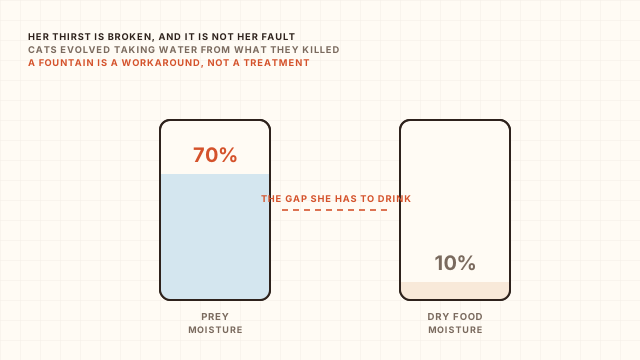
The domestic cat descends from a desert animal that took almost all of its water from what it killed. Prey runs around 70% moisture. An animal eating that does not need much of a thirst drive, and over a long time it stopped carrying one. The behaviour that replaced it is suspicion of standing water, which in a desert is usually stagnant and often the thing that kills you.
Dry food is about 10% moisture. Prey is about 70%.
Then we invented kibble. A cat on dry food has to make up that gap by drinking, deliberately, using an instinct she never evolved. Many manage. Many do not, and sit a little dehydrated for years, which is the background to a lot of the urinary trouble that sends cats to the vet.
Why moving water helps
Because it reads as safe. Running water, in the environment her ancestors came from, is the water that has not been sitting still. A fountain is not a clever product. It is a workaround for an instinct, and that is exactly why it works on cats who will not touch a bowl.
What it will not do
It will not treat anything. If your cat is straining, going more often, or going in the wrong places, that is a vet visit today and not a shopping decision. We sell a fountain. We are not going to stand next to a serious condition and imply we have something to do with it.
The cheapest version of this advice
Before you buy anything from us, try these, because they cost nothing and they work on a decent number of cats:
Move the bowl away from the food. In the wild, water next to a kill is water next to bacteria, and a lot of cats will not drink there.
Use a wide, shallow bowl. Whiskers touching the sides is genuinely unpleasant for her.
Put out a second bowl somewhere else entirely. Choice does a surprising amount of work.
Add a spoonful of water to wet food, or move one meal a day to wet food if your budget allows it.
If none of that moves the needle, a fountain is the next thing to try, and ours is on the shelf. But we would rather you tried the free version first and told us it worked.
Once a month
Get the measurements, not the offers.
One email a month. A teardown, a measurement, or something we got wrong. No discount codes, no abandoned cart chasing, and one click to leave.